Startups & Sports: My Overlapping Themes for Business and Masters Running
Several years ago, I stepped up to the start line of a master’s one-mile race in Columbia, South Carolina. Covid-related attrition had reduced the field to just me and two pacers. The announcer had taken to calling it the Dan King Show as I was there for a try at an age-group world record. A decent crowd had gathered for the evening's pro events and decided to stick around for my attempt.
I remember the anxiety. The mile is an unforgiving event — go out too hard and you’ll pay dearly over the final lap. And I was trying to do something I genuinely didn't know I could do. Standing on that line, I felt something familiar. It was the same feeling I'd had in the early days of my startup.

2020 Masters One-Mile race in Columbia, SC, when Dan King broke the M60 world age group record. Photo credit: lane1photos.com
I ran a perfect race. I fed off the crowd, could feel people pulling for me. I was on record pace through the half mile. The third lap is the moment of truth — where you learn whether you've gone too hard, too early. I found I could keep pressing as I moved down back stretch, which gave me the confidence I needed. As my pacer said: "Anyone can stand 60 seconds of suffering. Let's go."
As a 61-year-old, I ran the mile in 4:49 — nearly three seconds better than the existing M60 world age group record. I flatter myself a little by placing my name on a short list: Roger Bannister was first to break the 4:00 barrier. John Walker was first to go sub 3:50. I became the first over-60 runner to break 4:50.
What made that race possible wasn't just talent. It was a system — one I'd been building for over a decade, through injuries and setbacks and a complete reimagining of how I trained. And when I step back and look at that system honestly, I see the many similarities to the architecture that built ReadyTalk, the Denver-based conferencing company that I, along with my brother Scott and a small talented team bootstrapped from nothing to a very successful exit over sixteen years. Same principles. But two very different arenas.
Here are five themes central to both journeys — and four deeper traits I've come to believe hold them together.
1. Start with Vision
In the late 1990s I was a corporate finance professional at a telecommunications company called ICG, seeing everything through a finance lens. Then, in an airport bookstore on the way to a Florida vacation with my wife, I picked up Jim Collins's Built to Last. Reading it changed the direction of my life.
Collins made an evidence-based argument that vision — not superior talent, not lucky timing — is what distinguishes great companies from middling ones. He also noted that only two of the twenty-two great companies in his cohort were still in their original business. That was liberating. A perfect idea wasn't a prerequisite. What mattered was a clear and compelling vision.
I came back from that trip and led my finance team through a vision-building exercise. The energy was unlike anything I'd experienced at work. Word got around. I was asked to run similar sessions with other teams, and eventually with the executive leadership team — which felt like a genuine breakthrough.
It wasn't. Most of those executives treated it as a time-wasting corporate exercise. The output was so insincere it was embarrassing. And that failure became my catalyzing moment: if I was going to be part of something great, I was going to have to build it myself.
The Collins’ vision model has two interlocking pieces: Core Ideology — your purpose and values — and an Envisioned Future — your goals and a vivid picture of what success looks like. Together they function as compass and destination. Without both, you wander.
What I've also come to appreciate is the relationship between vision and process. Big goals are motivating, but the people who actually reach them are usually the ones who have learned to find genuine meaning in the daily work — the training session, the coding breakthroughs, the customer call, the retrospective. The outcome gives direction; the process gives fuel. The 4:49 mile didn't happen because I fixated on the clock. It happened because for ten years I showed up for the workouts, studied the science, and found satisfaction in incremental improvement that most people would never notice. The goal gave me direction. The process got me there.
2. Build an Intentional Culture
Vision is not culture — but vision is the foundation for a strong culture. How you put your values into practice, what you communicate and how often, how much you trust and empower your people to make progress, and what opportunities for growth you create: these are what build culture. The beer kegs and ping pong tables are artifacts. They'll get mentioned in your Glassdoor reviews, but they are not the culture.
At ReadyTalk, culture was never accidental. We were deliberate about the values we hired for, celebrated, and — when necessary — enforced. The result was a company consistently recognized as a top place to work, including being named the #1 medium-sized company to work for in North America by Outside Magazine in 2014. More importantly, it was a team that showed up for each other when things were hard.
3. Surround Yourself Wisely
In the final years of my corporate career, my company hired someone from Lucent Technologies to run our product organization. On paper, this person looked like a rock star — an industry luminary, probably a genius. In real corporate life, they were an absolute terror. I still have a vivid memory of this person climbing onto the conference room table during a leadership meeting to amplify the effect of screaming at colleagues on the other side of the room.
I made a firm decision that day: no assholes. Not in my company. Not ever.
That decision shaped every hire we made at ReadyTalk. We used the Gallup language of talent — recurring patterns of thought, feeling, and behavior — rather than simply hiring for skills and experiences. We built cultural filters into our process and refined them continuously. Our retrospectives on bad hires revealed consistent patterns: information hoarders, arrogant performers, controlling managers, people who disparaged colleagues, spotlight chasers. We screened hard against all of them.
Startups are defined by the quality of their early hires. This is not hyperbole. The first ten or twenty people establish culture, operating norms, and the bar for everything that follows.
The same principle applies to your co-founders, board members, advisors, investors — and your personal circles. Scott and I were genuine co-founders: complementary strengths, shared values, honest with each other even when it hurt. In running, it means finding a coach who understands masters physiology and training partners who push you honestly and celebrate your wins without envy. The quality of your circle is a competitive advantage in every arena.
4. Adopt a Growth Mindset
“Love challenges, be intrigued by mistakes, enjoy effort, and keep on learning.”
Carol Dweck draws a clear line between two orientations. A fixed mindset holds that your abilities and intelligence are fixed traits — a birthright. A growth mindset holds that they can be developed through dedication and hard work. Your innate abilities are a starting point, not a ceiling.

2024 1500m World Championship Final (Sweden), won by Dan King.
Photo credit: shaggysphotos.com
As a college distance runner, and even well into my early master’s years, I had a fixed mindset about my running. I worked hard and was solid, not great, and I accepted that as my ceiling. It wasn't until after fifty that I got genuinely curious about the science of endurance training — and discovered how much was knowable, applicable, and genuinely transformative. I also stopped taking competitive athletics for granted. I became engrossed by the puzzle of how to keep improving despite recurring injuries and the simple reality of aging. My results have been, frankly, exceptional.
Here's the thing about a growth mindset that took me years to fully internalize: the competition that matters most is with your own upper limit of potential. When my 4:49 world record got discussed on message boards and someone inevitably suggested I must be cheating — and it did happen — I found it more amusing than irritating. I grew up wearing a t-shirt that said: "My sport Is Your Sport’s Punishment." What those skeptics didn't see was a decade of meticulous self-study, experimentation, and honest measurement. I wasn't chasing other people's times. I was chasing my own ceiling, which I kept finding was higher than I'd assumed.
That orientation — competing primarily against your own internalized standards rather than fixating on others — turns out to be both psychologically healthier and strategically smarter in business too. The companies I've admired most weren't obsessed with their competitors. They were obsessed with their own benchmarks for excellence.
For entrepreneurs, this means building a learning organization. Your job is not to prevent all failures — that's impossible, and the attempt is counterproductive. Your job is to ensure that every cycle of failure and success builds organizational knowledge. Celebrate and reward effort. Manage what's controllable. Create the conditions where people feel safe to take intelligent risks and honest stock of what happened.
5. Stress + Rest = Growth
Growing up as an athlete, I believed more was better and harder was better. "No pain, no gain" wasn't just a slogan — it was a philosophy. It took me a long time to fully appreciate the role of rest in a training program. Counterintuitively, rest is not the absence of progress. It is where progress actually happens.
The physiological principle is well established: apply stress to the body, allow adequate recovery, and adaptation occurs. Too much stress without recovery produces injury, chronic fatigue, and burnout. Too little stress produces complacency and decline. Growth lives precisely in the tension between the two.
The business equivalent is equally real and equally misunderstood. Startups that never push hard stay small and eventually irrelevant. Startups that grind without rhythm or recovery burn out their people and erode their culture. The leaders I've admired most are the ones who understand when to push and when to pause — for their teams and for themselves. Here's a detail I find genuinely interesting: Nobel Prize-winning scientists are three times more likely to have serious hobbies than their peers. The breakthroughs don't come from more grinding. They come from the space between it.
What I've come to appreciate more deeply is that physical fitness isn't just something I do alongside the work — it actively enables the work. The discipline of sustained athletic training builds something in you that transfers directly to the demands of leadership: stress tolerance, the ability to stay composed under pressure, equanimity when things go sideways. Those are not personality traits you either have or don't. They are capacities you can train. The track has been my laboratory for developing them.
As a CEO, this translated into something specific: understanding the cycles of intense push toward goals and the critical importance of cadences that include rest, reflection, and renewal. My overnight success breaking records was anything but overnight — it was the visible tip of a decade of patient, intelligent development. The same was true of ReadyTalk.
The Long Road — and Why Identity Matters
I should explain how ReadyTalk actually started, because the origin story is load-bearing for everything above.
I founded Ecovate in 2000 with a partner, near the peak of the dot-com bubble — a specialized hosting company targeting emerging communication service providers. The timeline was extraordinary: I was still working full-time at ICG in April 2000. I quit in May, built a business plan, recruited a team, negotiated a lease, secured a term sheet by July, and closed $13.5 million in equity and $5 million in debt by September. We hired Scott to run sales shortly after.
By the first quarter of 2001, the conversation had changed entirely. The dot-com bubble had burst. The economy entered nuclear winter. In June 2001 — exactly one year to the week after incorporating — we signed an agreement with our VCs to separate and dispose of the assets. And I was fired.
I've thought a lot about why that didn't end my story. Part of it was stubbornness. Part of it was Scott. But I think the deeper reason is that I never defined myself solely as "a startup CEO." My identity was broader than that — something closer to someone who builds things, competes hard, and keeps learning. When that particular vehicle got totaled, I wasn't totaled with it. I could rebuild.
People who tie their entire identity to a single role — a title, a company, an event — tend to be devastated when that thing fails or ends, as it almost always eventually does. The athletes I've seen struggle most with being masters runners are often the ones who can't let go of who they used to be. They're grieving a former self instead of building a current one. The same pattern shows up in business founders who can't adapt after an exit, a pivot, or a failure.
A broader identity isn't a lack of commitment — it's actually a source of resilience that lets you commit more fully, because the stakes of any single failure are more survivable. Getting fired from Ecovate was, as it turned out, the precondition for building something much better. The Ecovate failure and the injury-riddled years of my early masters career were not detours. They were the road.
Scott and I pivoted, bootstrapped, and built ReadyTalk from nothing to over $30 million in recurring revenue. We were recognized as EY Entrepreneurs of the Year. ReadyTalk was consistently named a top place to work. In 2017, we achieved a successful exit. The trajectory was not linear. It never is.
The Formula
Standing on that start line in Columbia, about to attempt something I didn't know I could do, I felt the same thing I felt in the earliest days of ReadyTalk: clear purpose, earned preparation, and genuine uncertainty about the outcome. That combination — purpose, preparation, willingness to be uncertain — is, I've come to believe, the signature of anyone who has done something genuinely hard.

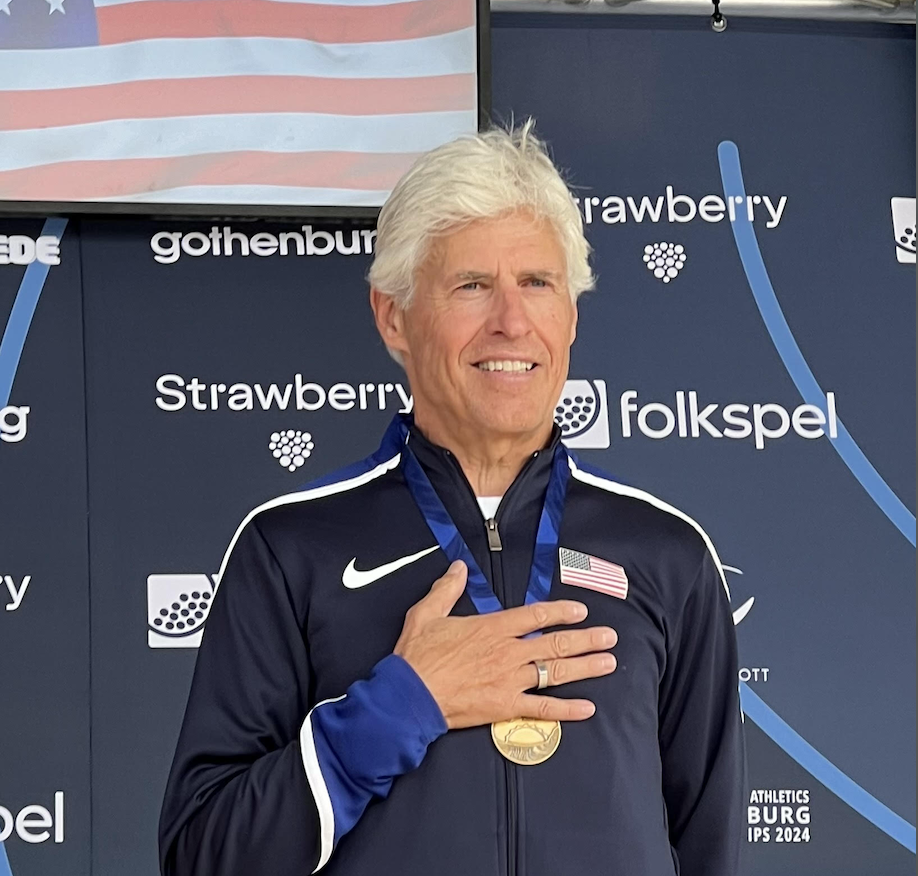
3x Gold Medalist Dan King at the 2024 Outdoor World Championships in Gothenburg, Sweden.
The five themes — vision, intentional culture, wise surroundings, growth mindset, and the discipline of stress and recovery — are the architecture. But underneath them are the traits that make the architecture functional: a love of the process alongside hunger for the outcome; the habit of competing against your own best rather than someone else's; a belief that physical discipline builds the mental infrastructure for everything else; and an identity capacious enough to survive the inevitable setbacks without being defined by them.
These aren't things I was born with. They developed — through mileage, through failure, through paying attention. Anyone can stand 60 seconds of suffering. The question is whether you've done the work to earn the right to that final lap.